




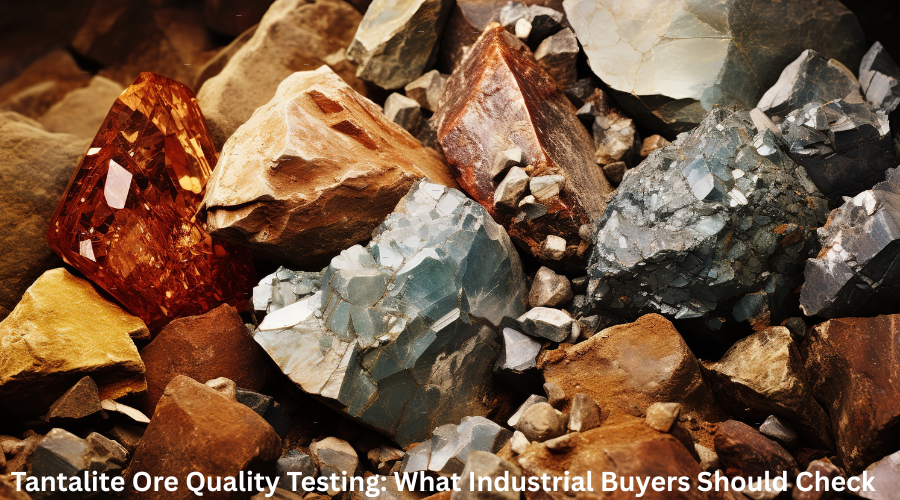
Tantalite ore sourcing has lots of risks involved, and the number one is related to conflict zones. Countries in Africa have the highest reserves of tantalite ore, but some of them have a grave issue. That is the issue of human rights violations, and companies that source ore from them could face legal challenges in court. So, sourcing has to comply with global safety and ethical standards. Electronics, aerospace, implants, and various industries rely on tantalum, which means they need to source it in massive volumes. To keep the supply active, they look for reliable suppliers of tantalite ore. Quality testing is what helps buyers ensure they are not going in the wrong direction.
If you are one of them, you need to follow all these quality testing methods before going on massive-scale sourcing.
The first inspection is the physical appearance one. Analysts inspect the appearance by looking at the color of tantalite ore, which must be black, dark brown, or reddish brown. The color ranges among these three prominent shades. Besides these shades, there is another element to consider, which is the luster. Tantalite ores have a metallic luster, which helps experts differentiate them from similar ore types.
There is another test to identify these ores, which is the hardness test. Analysts inspect the hardness level through the Mohs scale. The standard hardness of tantalite ore is between 6 and 6.5. If you are an industrial buyer, you need to use the Mohs scale method. This method will help you identify the tantalite ore for the kind of application you need it for.
Then the density test comes in, in which analysts have to ensure they are choosing the authentic ore. Experts use the water displacement method and some similar methods to measure the density of tantalite ores. The allowed density is 8 grams per cubic centimeter, and you need to keep it in mind before going for the ore procurement process.
The rubbing test helps experts to find out the authenticity of ore. It is also known as the streak test in the ore industry. What they do is rub the ore sample on an unglazed porcelain streak plate. By doing that, they measure whether the ore leaves a streak. If it leaves the exact color as the main ore, the quality is declared authentic.
Then there are some third-party tests that provide traceability, element concentration, radioactive elements’ presence, and much more information. Their documents work as evidence to prove the quality of the ore you are procuring. Here are some of those tests that assist professionals in complying with global standards when sourcing tantalite ore.
XRF is a non-destructive testing method that helps with traceability of tantalite ore. The ore releases trace elements through X-ray fluorescence testing, which helps buyers verify the source of tantalite ore. It is important because there are some conflict zones in Africa where human rights violations take place in the extraction process. It is a deep chapter, which could unfold lots of side information. To avoid suspected ores from conflict zones, buyers need to use XRF analysis.
Then another analysis takes place, which is ICP-OES (Inductively Coupled Plasma Optical Emission Spectrometry). This test helps companies detect elements like niobium, tantalum, manganese, iron, tungsten, molybdenum, and tin. With the help of this test, multiple elements are tested simultaneously.
Another analysis is SEM-EDS (Scanning Electron Microscopy with Energy Dispersive X-ray Spectroscopy). It helps to detect impurities through surface topography. What it does is provide a high-resolution microstructural image. Then the composition details, impurity levels, and traceability become identifiable. It also helps to identify the concentration of tantalum pentoxide (Ta₂O₅) and niobium pentoxide (Nb₂O) in tantalite ores.
The accepted radiation levels are low to moderate in tantalite ores. It happens because uranium and thorium are present in it. During the refining process, these elements have to be removed for the pure extraction of tantalum and niobium.
Since there are lots of risks involved in the supply chain process of tantalite ore, traceability is very essential. It helps buyers to identify the difference between ore that was extracted from a verified source and ore that was extracted from a conflict zone. Sourcing from a conflict zone can bring problems regarding human rights violations.
The ores of tantalite should originate from verified zones to comply with safety and ethics worldwide. OECD and RMAP standards help companies adhere to safe supply chain standards. These standards guaranty that the tantalite ore was not mined in a conflict zone and that there were no human rights abuses in the mining process.
Industrial buyers have to go through multiple steps to ensure the tantalite ore they are sourcing complies with global standards. The purity, traceability, and compliance factors rely on all the tests that we mentioned in this blog. Appearance, hardness, density, streak, and radiation levels are some primary inspection factors. To avoid sourcing tantalite ore from a conflict zone in Africa, these tests are mandatory. Not complying with supply chain standards could lead a buyer to face lots of legal issues later. This is why traceability is crucial in this entire process. Even if you procure the best ore in terms of quality and price, if it is from a conflict zone, things might go in the wrong direction.
What is the Accepted Hardness Level of Tantalite Ore in Quality Testing?
The accepted hardness level of tantalite ore is with a Mohs hardness rating of 6–6.5.
What Kind of Third-Party Analysis Do Experts Perform for Tantalite Ore Testing?
Experts have to perform XRF analysis along with ICP-OES and SEM-EDS analysis of tantalite ore. It helps them determine the traceability and purity of the ore.
How to Identify Tantalite Ore in Physical Appearance Test?
The color must be black, dark brown, or reddish brown if you are sourcing tantalite ore. These color ranges define the authenticity of ore. The streak test helps to find out the authenticity of the color.
What Density Level of Tantalite Ore Complies with Global Standards?
Experts use the water displacement method to test the density of tantalite ore. That density has to be 8 grams per cubic centimeter.
Tantalite ore sourcing has lots of risks involved, and the number one is related to conflict zones. Countries in Africa have the highest reserves of tantalite ore, but some of them have a grave issue. That is the issue of human rights violations, and companies that source ore from them could face legal challenges in court. So, sourcing has to comply with global safety and ethical standards. Electronics, aerospace, implants, and various industries rely on tantalum, which means they need to source it in massive volumes. To keep the supply active, they look for reliable suppliers of tantalite ore. Quality testing is what helps buyers ensure they are not going in the wrong direction. If you are one of them, you need to follow all these quality testing methods before going on massive-scale sourcing. Appearance The first inspection is the physical appearance one. Analysts inspect the appearance by looking at the color of tantalite ore, which must be black, dark brown, or reddish brown. The color ranges among these three prominent shades. Besides these shades, there is another element to consider, which is the luster. Tantalite ores have a metallic luster, which helps experts differentiate them from similar ore types. Hardness There is another test to identify these ores, which is the hardness test. Analysts inspect the hardness level through the Mohs scale. The standard hardness of tantalite ore is between 6 and 6.5. If you are an industrial buyer, you need to use the Mohs scale method. This method will help you identify the tantalite ore for the kind of application you need it for. Standard Density Then the density test comes in, in which analysts have to ensure they are choosing the authentic ore. Experts use the water displacement method and some similar methods to measure the density of tantalite ores. The allowed density is 8 grams per cubic centimeter, and you need to keep it in mind before going for the ore procurement process. Rubbing or Streak Test The rubbing test helps experts to find out the authenticity of ore. It is also known as the streak test in the ore industry. What they do is rub the ore sample on an unglazed porcelain streak plate. By doing that, they measure whether the ore leaves a streak. If it leaves the exact color as the main ore, the quality is declared authentic. Neutral Tests or Third-Party Inspection Then there are some third-party tests that provide traceability, element concentration, radioactive elements’ presence, and much more information. Their documents work as evidence to prove the quality of the ore you are procuring. Here are some of those tests that assist professionals in complying with global standards when sourcing tantalite ore. XRF Analysis XRF is a non-destructive testing method that helps with traceability of tantalite ore. The ore releases trace elements through X-ray fluorescence testing, which helps buyers verify the source of tantalite ore. It is important because there are some conflict zones in Africa where human rights violations take place in the extraction process. It is a deep chapter, which could unfold lots of side information. To avoid suspected ores from conflict zones, buyers need to use XRF analysis. ICP-OES Analysis Then another analysis takes place, which is ICP-OES (Inductively Coupled Plasma Optical Emission Spectrometry). This test helps companies detect elements like niobium, tantalum, manganese, iron, tungsten, molybdenum, and tin. With the help of this test, multiple elements are tested simultaneously. SEM-EDS Analysis Another analysis is SEM-EDS (Scanning Electron Microscopy with Energy Dispersive X-ray Spectroscopy). It helps to detect impurities through surface topography. What it does is provide a high-resolution microstructural image. Then the composition details, impurity levels, and traceability become identifiable. It also helps to identify the concentration of tantalum pentoxide (Ta₂O₅) and niobium pentoxide (Nb₂O) in tantalite ores. Radiation Levels The accepted radiation levels are low to moderate in tantalite ores. It happens because uranium and thorium are present in it. During the refining process, these elements have to be removed for the pure extraction of tantalum and niobium. Traceability and Supply Chain Safety Compliance Since there are lots of risks involved in the supply chain process of tantalite ore, traceability is very essential. It helps buyers to identify the difference between ore that was extracted from a verified source and ore that was extracted from a conflict zone. Sourcing from a conflict zone can bring problems regarding human rights violations. The ores of tantalite should originate from verified zones to comply with safety and ethics worldwide. OECD and RMAP standards help companies adhere to safe supply chain standards. These standards guaranty that the tantalite ore was not mined in a conflict zone and that there were no human rights abuses in the mining process. Conclusion Industrial buyers have to go through multiple steps to ensure the tantalite ore they are sourcing complies with global standards. The purity, traceability, and compliance factors rely on all the tests that we mentioned in this blog. Appearance, hardness, density, streak, and radiation levels are some primary inspection factors. To avoid sourcing tantalite ore from a conflict zone in Africa, these tests are mandatory. Not complying with supply chain standards could lead a buyer to face lots of legal issues later. This is why traceability is crucial in this entire process. Even if you procure the best ore in terms of quality and price, if it is from a conflict zone, things might go in the wrong direction. FAQs What is the Accepted Hardness Level of Tantalite Ore in Quality Testing? The accepted hardness level of tantalite ore is with a Mohs hardness rating of 6–6.5. What Kind of Third-Party Analysis Do Experts Perform for Tantalite Ore Testing? Experts have to perform XRF analysis along with ICP-OES and SEM-EDS analysis of tantalite ore. It helps them determine the traceability and purity of the ore. How to Identify Tantalite Ore in Physical Appearance Test? The color must be black, dark brown, or reddish brown if you are sourcing tantalite ore. These color ranges define the authenticity of ore. The streak test helps to find out the authenticity of the color. What Density Level of Tantalite Ore Complies with Global Standards? Experts use the water displacement method to test the density of tantalite ore. That density has to be 8 grams per cubic centimeter.
READ FULLThe purchase of tantalite ore is not as simple as purchasing any normal commodity. This includes regulatory compliance, quality checks, and complex international trade logistics. As a mineral trader, an industrial processor, or a mineral manufacturer, if you can get the right questions answered before you enter into a purchase, you'll avoid a lot of headaches along the way. This guide is designed to help any buyer with the most important questions to ask. What is the source of the ore? When contacting any tantalite supplier, ask them for the source of the ore. There are several reasons why origin is important. The standards for regulatory compliance, ethical sourcing, and product quality may differ greatly from country to country and from mine to mine. Some sources of tantalite are more under regulatory scrutiny than others. Conflicts in Central Africa not only affect people but also restrict access to resources, such as mineral ore products, found in these countries. A supplier should be able to provide evidence of the ore's origin and how it was traced to the orphan mine. Request a chain of custody that specifies where the ore came from and where it was delivered to your point of purchase. A real supplier will be willing to provide this readily available. That's a significant red flag if the supplier can't clearly validate the source. Does the Supplier Have Conflict-Free Certification? The issue of conflict minerals in the tantalite trade is well documented. Mining areas have, in some instances, historically been a conduit for armed groups to raise money through the sale of minerals. The use of ore purchased with funds that conflict puts your business at risk of legal liability, reputational issues, and ethical responsibility. Request that all suppliers provide a conflict-free certificate. Perhaps most well-known is the OECD guidelines for ethical mineral sourcing from unstable and high-risk regions. These should already be familiar to suppliers exporting to major markets. There are also some regional certification schemes. Tantalum is included in the International Tin Supply Chain Initiative, along with tin, tungsten, and gold. Another certified program is Certified Trading Chains in Central Africa. Inquire about the certification scheme your supplier is involved in and check their standing with the scheme. What Is the Tantalum Content of the Ore? Tantalite ore is priced based on the amount of tantalum pentoxide as a percentage. Higher-grade ore has a higher tantalum content and a higher price. However, there is more to it than just grades. The niobium content, moisture, and other minerals influence the market value of the ore. Ask your supplier for an assay report. An assay is a chemical analysis of the ore that shows the exact mineral composition. It should be carried out by an independent accredited laboratory, not just by the supplier. Check for consistency by comparing the assay results using more than one batch. Inquire also about the particle size distribution and moisture content. These impact the processing of ores in downstream operations. When you know the actual mineral content of the product you are purchasing, you can perform the necessary calculations to determine the true value of the purchase. Is the Ore Legally Exported? Legal export compliance is a must! Tantalite is a regulated mineral in most of the producing countries. When exporting, proper government permits and customs documentation are required, along with approval from national mining authorities. Ensure that your supplier faxes and sends copies of all export permits and customs clearance documents before shipment. Verify that the exporting company is registered and licensed for mineral trade in their country. In some countries, exports of mineral products must be registered with the country's mineral tracing system, as in the DRC and Rwanda. Verify if your supplier is registered. Check import regulations in your own country. Some markets require specific documents to import minerals. These include; certificates of origin, quality certificates and in some cases pre-shipment inspection reports. If you know how the transaction works, you will not have any customs issues and legal glitches. How is the ore packaged and shipped? Tantalite ore is a dense mineral. Logistics for shipping must be well organized. Check with the supplier about the packaging of ore. Standard packing is generally woven polypropylene bags, 50–100 kg per bag, with pallets for loading into the containers. Depending on their processing setup, some buyers choose to purchase in big bags or to bulk-load into containers. Inquire about moisture protection for shipping. Tantalite ore can absorb moisture in transit, impacting weight and potentially making the processing more challenging. This can be minimized by using proper packaging and sealing of containers. Specify the shipping terms, definitely. Know how the quoted price is defined, as FOB, CIF, or otherwise. The responsibilities for freight, insurance, and customs change from term to term. Having exact knowledge about what is included in the price, you will have nothing unexpected when you arrive. What are the supplier's terms of payment? Careful attention is needed to payment terms in mineral trading. There's a lot of money at stake, and there is a risk of fraud in this area. Do not pay all of a supplier's bill without having met them before. Inquire about the type of payment. A typical arrangement would be for a portion of the transaction to be paid in advance, with the remainder paid as the transaction proceeds, since it is a shipping-document-based transaction. In bigger transactions, letters of credit provide payment protection to both parties. Trade assurance options are more beneficial for smaller orders and can be provided on B2B platforms. If this is your first transaction, ask whether the supplier will allow a third-party escrow account. If the supplier is trustworthy and knows their product, they should be able to agree to secure payment terms. If anyone resists any payment protection, it's a red flag. Can the Supplier Provide References from Previous Buyers? Experience is important in the selling of minerals. Request references from your supplier from past customers, especially those in a similar market or industry. Talking directly with current customers will provide a real-life performance of the supplier's reliability, product consistency, and level of communication. A reliable supplier would not hesitate to put you in touch with happy customers. What If There is A Quality Dispute? Quality issues are not uncommon in the mineral trading market. Poor-quality ore, where the grade is not up to the desired requirements or the moisture content is high, results in financial loss. Request from your supplier the procedures for handling quality disputes. If possible, ask if they have a pre-shipment inspection system in place. It is best to have an inspection company by a third party to ensure that the grade, weight, and packaging are correct before the ore leaves the country of origin, to eliminate the possibility of disputes. Question the inspectors you have worked with and ask if they can grant access to your appointed inspector. Also, make sure to explain how any conflicts will be resolved within your buy agreement. With respect to the manufactured ore, specify what is to be done if it is not of the required quality. The contract terms are clearly outlined, which makes it quicker and easier to resolve issues should there be any. Is the Supplier Financially Stable? This is one of those questions that many buyers do not take seriously. When a supplier accepts your deposit for goods but then is unable to fulfill the order, they are leaving you in a difficult situation. Inquire about the supplier's business background, years in operation, and annual deal amounts. Ask for business registration and information about any finances they are willing to provide. If you're ordering in bulk, simple financial checks on the supplier are a matter of integrity. When you deal with well-documented, established suppliers, the likelihood that they will fail to perform is significantly reduced. You can also check this article: What Is Tantalite Ore? A Complete Beginner’s Guide Conclusion The preparation and diligence needed to buy tantalite ore are important. These questions apply to the topics of origin, compliance, quality, logistics, payment, and supplier reliability and are contained in this guide. All answers before ordering will reduce your risk of costly mistakes after ordering. Ask them all before deciding to buy something. FAQs Where to obtain Tantalite Ore in bulk for a retail item? You can purchase from certified mineral suppliers and exporters in Rwanda, Nigeria, or Australia. This can be done through B2B portals such as Alibaba. Where can I purchase Tantalite Ore at wholesale at a competitive price? Get in touch with mineral vendors directly for licensed minerals, without third parties in between, to reduce per-ton costs. Shop around and secure quotes from multiple verified suppliers. How can I find a supplier for Tantalite ore who can also customize it? There are various mineral processing firms and exporters that can help you achieve the desired ore grade, tantalum concentration, particle size, and packing specifications as per your ore processing needs. Contact with processing firms in China and Germany, as well as with the main African exporters serving the industry and manufacturing sectors. Do any suppliers offer bulk supply of tantalite ore with customization and good rates? Yes, bulk tantalite exporters are available in China and some other African countries, with custom-grade and particle-size specifications and packing at competitive factory-direct prices.
READ FULLTantalite ore is not a familiar name to most people. They are using it every day, however. That's in your smartphone, your computer, and your car's electronics! This is one of the most critical minerals used in technology today. But it is little known beyond the mining and manufacturing world. This guide will cover the definition, origin, processing, and significance of tantalite ore beyond what most people perceive. Explaining Tantalite ore Tantalite is a mineral and a source of two important metals, tantalum and niobium. It's the biggest world source for tantalum. It belongs to a family of minerals called columbite-tantalite, also known as coltan. The ore occurs as part of a pegmatite body or granite body in the ground. An igneous rock that is more textured than any other was formed by the concentration of rare minerals in the rock, and is called pegmatite. It is there that most tantalite is found. Tantalum is a hard metal. It is blue-gray in color. It has poor corrosion resistance. It can withstand extreme temperatures. And it is very effective for electronic parts. They make it one of the most in-demand industrial minerals worldwide today. Tantalite ore is found worldwide. Tantalite deposits have been found in various parts of the world. However, some countries contain the largest reserves in the world. Africa The neighboring nations of the Democratic Republic of the Congo and Rwanda account for a global tantalite production at a significant proportion. The DRC has huge mineral resources, especially coltan. Tantalite is also mined in some other African nations, in not insignificant quantities in Nigeria, Ethiopia, and Mozambique. Australia The Greenbushes and Wodgina mines in Western Australia were once the biggest producers of tantalum in the world. There has been a slowdown in production in recent years, but Australia is still a significant supplier to international supply ranges. Brazil and Canada Brazil has some interesting tantalite deposits, specifically in the state of Minas Gerais. There are also deposits in Canada, but not as widely exploited as those on the African continent and in Australia. Both countries are still engaging in exploration activity, and demand is rising in the world market. Mining Process of Tantalite Ore Mining for tantalite is dependent on the location of the deposits. Open-pit or underground methods are used in large-scale industrial operations. Ore is mined with heavy machinery, and the rock is crushed and processed in order to get the valuable minerals and remove the waste rock. Artisanal mining occurs in certain central African areas. Small groups of miners dig by hand using basic tools. This is a labor-intensive process and is frequently carried out far from infrastructure in the jungle. Artisanal mining has become a major source of coltan supply in the world, but it has serious human rights and environmental concerns. The ore is concentrated after extraction. Gravity separation and floating methods are used to separate the tantalite from other particles. The concentrated ore is then passed out to processors, where they remove pure tantalum for use in industry. What happens with Tantalite after it is mined? Mined and concentrated tantalite ore is transported to the processing centers. Most processing takes place in China, Germany, and the USA. These plants are used to extract tantalum from ore using hydrofluoric acid and solvent extraction. This produces tantalum powder or tantalum metal ingots. This can be sold as a service to manufacturers producing components from it. The highest demand and most useful is the tantalum capacitor. It is one of the smallest and most pivotal components in nearly all electronic devices created today. Role of Tantalum in Electronics They are small and strong, with a wide temperature range. They store more charge in less space than any other type of capacitor. This is perfect for small, contemporary gadgets such as smartphones, tablets, and wearable gadgets. These days, almost all smartphones have several tantalum capacitors on board. So are laptop computers, digital cameras, hearing aids, pacemakers, and car digital systems. Tantalum is essential to create devices as small and efficient as they are today. Besides capacitors, tantalum is used in superalloys for jet-engine parts exposed to very high temperatures. It has been used in surgical implants because it is well-tolerated in the human body. Medically, it is also used in chemical processing machinery, due to its resistance to corrosion in severe acid conditions. Tantalite Ore and Coltan: similarities and differences Coltan means mixed minerals; columbite-tantalite, which includes some of both minerals. The range of the mineral series in which there is an excess of tantalum over niobium is termed tantalite. In practice, the terms are used interchangeably in mining regions worldwide, particularly in Central Africa—the coltan mines in the DRC supply tantalite. Manufacturers are the ones that are interested in the tantalum-rich parts of this ore that have the most commercial value. Ethical Issues Regarding Tantalite Mining This is one of the more serious problems associated with tantalite. In some parts of central Africa, mining is carried out in or near areas of conflict. Coltan exploitation has sometimes been used to pay armed groups to perpetrate violence and regional instability. This made coltan a coal-black conflict mineral alongside the other Black Coal Minerals: gold, tin, and tungsten. In response to the problem, international regulations have been made. In the United States, the Dodd-Frank legislation mandates that companies report on the use of minerals from conflict-affected regions (CAES) in the DRC. The OECD also has detailed guidance for companies to follow on Responsible mineral supply chains. Several key technology firms are now carrying out supply chain audits. They strive to ensure their tantalum is sourced from verified, responsible suppliers. There are signs of greater transparency than ever before, from the mine to the manufacturer, with certification schemes and blockchain-based traceability tools. How is the mining of Tantalite regulated in countries? Different countries have different regulations. It is noted that mining in Australia and Canada is subject to strict environmental and labor laws. Permits and an environmental evaluation are required for businesses to obtain after mining, and rehabilitation requirements must be met when mining ceases. In African producing countries, regulations are improving, but are weak in certain areas. The parliaments of Rwanda and DRC have implemented mineral-tracing programs as a means of better supervising the artisanal mining sector. International initiatives have boosted the standards in the region through collaborations, including with the International Tin Supply Chain Initiative. Demand for more regulation is becoming stronger. Consumers and investors are calling for a cleaner supply chain. It is this pressure that is making a difference in world trade and in the monitoring of tantalite mining. How Is the Tantalite Market Performing? As the consumer demand for electronics vehicles expands, so does that for tantalite. Tantalum products are used in electronics, including tantalum capacitors in EVs and advanced driver assistance systems. The world's EV market far outpaces the overall growth of the tantalum market. However, supply remains localized. This causes a fluctuation in price. Prices can rise quite dramatically when a conflict, weather, or other law changes disrupt production in mining regions. Engineers and governments are searching for ways to recycle tantalum from discarded electronics, in order to lower the demand for new ore. Technically, Tantalum can be recycled, and the process is becoming increasingly economical at higher prices. This has benefits on the environment, minimizes the supply chain, and alleviates strain on mining communities. Programs for the recovery of tantalum from e-waste are already in operation in some European and Asian companies. The future of Tantalite Ore Demand for tantalite is likely to remain healthy. Technology does not come to a halt. Increased demand for tantalum is expected to continue for the foreseeable future, driven by the growing number of connected devices, EVs, advanced medical equipment, and defense industry parts. In Africa, Canada, Greenland, and some Asian areas, the new deposits are being explored. Most of these projects are still in the initial discovery phase, but could provide some important supply in the next decade or two. Governments and industries are increasingly recognizing the strategic significance of tantalum, which is driving investment in the metal's mining. Meanwhile, the industry faces a genuine challenge to be more responsible in its mining operations. International environmental requirements are becoming more stringent. Technologies for traceability are rapidly evolving. The program for recycling is expanding. The common denominator is that everyone wants to increase their demand without the ethics or environmental failures that have plagued segments of this industry. Conclusion Tantalite ore may be tiny in the news cycle, but it has a huge impact. It is the core of new technology used in today's life. Knowing this information can make it easier to understand how a mine in Central Africa is linked to the device in your hand. FAQs Where can I buy tantalite ore in bulk? Purchase directly from trusted DRC, Rwanda, Nigeria, or Australian mining or export companies from websites such as Alibaba or Global Sources (B2B) What is the right way to purchase Tantalite Ore in Wholesale at an affordable price? Reach out to exporters and processors of minerals directly to bypass intermediaries and save them from expenditure Where to find suppliers of Tantalite ore that offer customization? There are several processors and exporters that have special grades, particle sizes, and concentration levels of tantalum depending on the use. Call processing units in China, Germany, and leading African exporters are frequently used by industrial end-users. Who offers bulk supply for Tantalite Ore at a low price with Customization? Yes, there are processors in China and some exporters in Africa willing to supply bulk tantalite with custom specifications at a competitive factory-direct price. Get a detailed quotation that lists grade, processing, and shipping costs before entering any orders.
READ FULL