




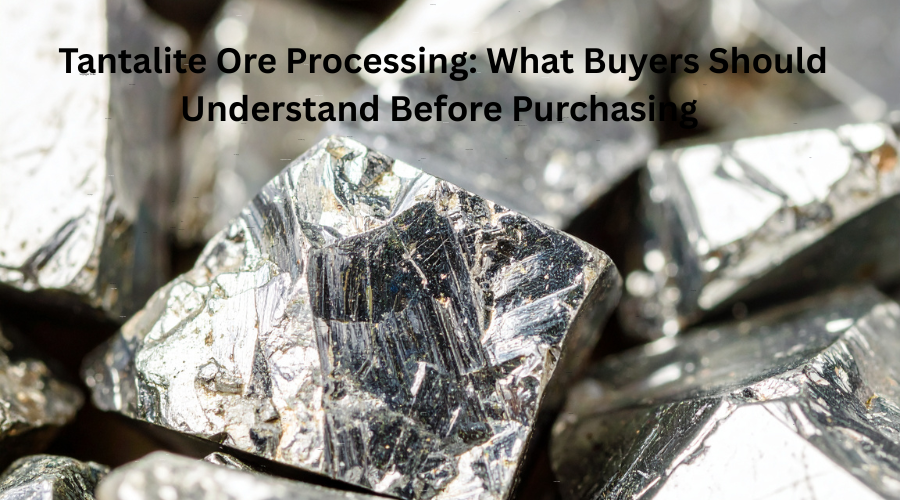
Tantalite ore processing is an extensive process where lots of steps take place. The impurities in tantalite ore are not easy to remove. Until an entire process of impurity separation takes place, these ores are not eligible for use in any industry. Industries need tantalum for capacitors, semiconductors, thin films, optical glass, carbides, ceramics, aerospace parts, etc. To extract tantalum, one has to refine the tantalite ore through a seven-step purification process. This process contains mining, crushing, milling, gravity separation, magnetic separation, refining, and electrolysis processes. Before all of these steps, the ore’s sourcing has to comply with safety and ethical standards.
The first step is the mining process, and this is where buyers have to focus the most. If you are sourcing tantalite ore, you need to ensure the source is not in a conflict zone. A few countries that top the list of suppliers of tantalite ore have some core issues. These issues are regarding human rights violations. So, if you are sourcing it, make sure you choose a supplier who avoids such practices in the ore extraction process.
Here is a brief look at the first step where the mining process takes place. After mining, the washing process starts, where the removal of mud and primary impurities takes place. The ores need this washing process in order to ensure the basic testing method of samples goes well. The sample, its composition, and the rest of the tests take place right after the mining process. It is for those who procure raw ores.
Then the second step starts, where the ores go through the crushing process. Industries use cone crushers to break down large ores into smaller rocks. This minimization process helps them turn a large ore into smaller rocks, so the milling process can take place. Some use jaw crushers to break down the ores depending on their requirements.
After large ores are broken down into small rocks, the milling process starts. Industries have ball mills to grind those tantalite rocks into much smaller particles. These mills have heavy metal or ceramic balls. Also, there are metallic or ceramic plates inside to help the balls break down and turn irregular rocks into a fine powdered form. Some mills have chromium, manganese, alumina, and zirconium balls depending on their requirements. After those rocks become a fine powder of tantalite, the next step of filtration starts.
The next step of filtration is about gravity separation. Industries use machines, aka shaking tables. Those tables have vibrating screen plates that filter the tantalite powder to remove impurities from it. Some have steel grids, and some have steel mesh. Some have rubber screens depending on the desired throughput rate. These are low-cost separation methods that help filter the primary impurities from the tantalite powder.
The next step is about removing metallic impurities from the tantalite powder for further filtration. The magnetic separation process contains machines that have magnetic plates inside to attract each metallic particle present in the powder. These magnets attract impurities like iron, tin, silicate, and similar metals from the mineral. Then the powder becomes free of such impurities for the desired quality of tantalum.
Then the refining process starts, which helps break down tantalite powder into tantalum and niobium. Industrial experts use hydrofluoric acid and sulfuric acid to perform this process; The acidic solution breaks down the tantalite to provide tantalum and niobium separately. This refining process is not enough because there are still some impurities that need to be removed from tantalum and niobium.
The seventh step is the electrolysis process, where the final purification takes place. This process takes place for the purification of tantalum. Professionals use potassium chloride, sodium chloride, and some similar salts to make a salt bath. Then they dip the tantalum into that salt bath to perform the electrolysis process. Metal ions migrate to the cathode in this process because that is how they remove contaminants from the tantalum. After that, they remove the salts from the accumulated tantalum at the cathode.
Once the final form of tantalum appears, they turn into bars through pressing machines.
Tantalite ore extraction and purification processes are mandatory to provide pure tantalum for various industrial uses. There are countless impurities in the ore, which need elimination through a multi-step process. The crushing, milling, gravity separation, magnetic separation, and a few other steps have to take place for this process. Since it is one of the most crucial minerals in the world for the electronics industry, its worth is very high. The purity level has to be above par because every electronic device relies on it to function efficiently.
How Can I Source Tantalite Ore in Large Volumes?
You need to find suppliers who comply with global safety and ethical standards. Tantalite ore sourcing process is crucial because lots of factors, like human rights violations and conflict zones, are involved in it. So, you have to choose a reliable name in the industry through strict verification, samples, traceability, and licensing. Once you find a supplier, ask for extraction quantity, supply capacity, documentation, and quotation.
What are the Applications of Tantalite?
They are used as capacitors and resistors in the electronics industry, which is their largest application. The entire electronics industry relies on them for efficient performance of devices. Besides, tantalite’s applications are mainly medical implants, surgical tools, aerospace parts, and automotive components. Almost all these industries are giants, and the demand for tantalite is huge among them.
How Many Steps Take Place in the Tantalite Ore Refining Process?
There are around seven steps in the tantalite ore refining process. It starts with mining, then goes to crushing, milling, gravity and magnetic separations, refining process, and electrolysis. All these steps take place to provide pure tantalum to industries like electronics, medical implants, surgical equipment, aerospace parts, and automotive parts.
Industrial buyers have to conduct due diligence on the ore and the supplier’s authenticity. They need to collect maximum information to finalize a supplier, and then perform a thorough analysis of the tantalite ore’s quality. It takes lots of time, but it is mandatory. This ore is the primary requirement for the production of semiconductors, alloys, and several other products in different industries. The greatest demands are in the electronics, automotive, and aerospace sectors. These giants need tantalite ores to extract tantalum and niobium for electronics, machinery, and other metallic products. Sourcing tantalite ores requires buyers to know the correct specifications, and this blog can help them. What is the Chemical Composition of Tantalite Ore? Before you read about the chemical composition, it is better to know about its formula. It is (Fe, Mn) (Ta, Nb)₂ O₆. Here, you can find multiple elements that show why it is crucial for multiple industries, especially the electronics industry. An entire sophisticated sector, semiconductors, relies on tantalum to manufacture microcomponents like semiconductors, capacitors, thin films, etc. They are like the core microcomponents that run every electronic device that exists. Let’s get to the main point, and it is chemical composition. Most tantalite ores have a high concentration of tantalum pentoxide (Ta₂O₅) and niobium pentoxide (Nb₂O). Then comes iron oxide and manganese oxide. Their compositions make tantalite ore a source of production for a wide range of products, especially in electronics, automotive, aerospace, optical glass, and carbide industries. If you are looking to buy it in large volumes, here is a beginner’s guide to tantalite ore. How Much Impurity Level is Acceptable When Sourcing Tantalite Ore? The maximum impurity level is between 0.1% and 0.5% when sourcing tantalite ore. Uranium, thorium, and some arsenic elements are present in this ore, and their limits have to be very low. Besides, there are some other impurities present in it, which are silica, zircon, and rare earth metals. Their concentration has to be very minimal because the core objective of sourcing tantalite ore is the extraction of niobium and tantalum. These two core elements are very essential for the production of semiconductors and alloys. How to Identify Tantalite Ore by Appearance? There are some ores, like coltan ores, that cause confusion for buyers. There are some similarities in both, but they are different. To differentiate tantalite ore, you need to focus on its appearance. It has shades like black, dark brown, or reddish brown, and the appearance varies in these shades. Besides, tantalite ore has a metallic luster, which makes its differentiation easy. Buyers need to know about these essential questions to ask when sourcing tantalite ore in large volumes. What is the Standard Hardness of Tantalite Ore? The standard hardness of tantalite ore is between 6 and 6.5 on the Mohs scale. If you are procuring in large volumes, it is better to ask for samples. Then you can test the hardness level on the Mohs scale to make sure you have compatible purity. Besides hardness level, you need to know some other factors also. How Much Radiation Levels are Acceptable? Since tantalite ores contain radioactive elements, you need to make sure they are very minimal. These elements are radium, uranium, and thorium, which have to be very low in concentration. There are different testing methods in industrial laboratories, and inspectors test gamma ray intensity using multiple pieces of equipment. What is the Standard Density of Tantalite Ore, and How to Test It? The standard density of tantalite ore is also part of the specifications you need to consider. The density has to be 8 grams per cubic centimeter if you are sourcing high-quality tantalite ore. Industrial inspection methods like the water displacement method can help you evaluate the density. It is a proven method that provides precise results when sourcing ores. Third-Party Tests in Tantalite Ore Inspection You need to have third-party tests conducted for the inspection process. Buyers like you need to have multiple tests performed to make sure tantalite ore meets global standards. Intertek, ISO, SGS, and some other prominent inspection bodies conduct these tests. Ask your supplier for the test reports that must prove that the tantalite ores they are supplying meet global criteria. Streak Test Another method to test the purity of ore is the streak test. It is also called a rubbing test, in which inspectors have to rub the ore sample on an unglazed porcelain streak plate. Then the ore leaves some color on that plate. If it leaves the exact color as the main ore, the quality is declared authentic. This test allows buyers to ensure the ore is not coated with color or other ways to hide the flaws. ICP-OES Analysis ICP-OES analysis helps you detect core elements in tantalite ores. With the help of this analysis, you can find out about the presence of niobium, tantalum, manganese, iron, tungsten, molybdenum, and tin. These elements matter a lot during the procurement process because each element, especially tantalum and niobium, is in high demand. XRF Analysis Another way to analyze the quality of ore is XRF analysis. It is also a non destructive testing method that is essential to the procurement process . It provides details like traceability of tantalite ore. This X-ray fluorescence test helps one detect trace elements released from ore. With the help of this test, buyers can know the mines or origin of ores. Comparing the claims of suppliers with the test analysis helps buyers find the right details about the authenticity of ores. SEM-EDS Analysis The last test is SEM-EDS (Scanning Electron Microscopy with Energy Dispersive X-ray Spectroscopy). This test helps detect defects like scratches on the ores through surface topography. In the production of semiconductors, this test helps prevent impurities and flaws in ores. SEM-EDS analysis shows the concentration of tantalum pentoxide (Ta₂O₅) and niobium pentoxide (Nb₂O). It provides a high-resolution microstructural image of the surface, so every flaw can become visible. Moreover, it shows details like composition, impurity levels, and traceability of ore. Conclusion Tantalite ores are a core requirement for industrial giants like the electronics sector. Semiconductors and other microcomponents need tantalum for production, and tantalum is extracted from tantalite ores. Now, you can imagine how important this ore is not only for electronics, but also for the automotive and aerospace sectors for alloys through the second byproduct, which is niobium. Industries have to source them in massive volumes to keep production going. For the procurement process, they need mining companies or global distributors, which are mostly from Africa. Here is how to source tantalite ore for industrial applications. FAQs Where Can I Find an African Supplier of Tantalite Ore Who Also Has Competitive Prices? You need to search on B2B platforms or look in online supplier directories. There is another option, which is a global distributor known as Afrique Gold Minier. You can contact them, get details, and decide if they meet your requirements. Can an Intermediary or a Trading Company Help Me Source Tantalite Ores in Low MOQs? Yes, some trading companies can help industrial buyers source tantalite ores. They can reduce the effort and complexity of the sourcing process. Afrique Gold Minier is also a trading company that takes queries from buyers and then sources ores from mining companies. Buyers need to select suppliers through complete analysis to ensure there is no flaw in the sourcing process. How to Test Samples of Tantalite Ore to Verify the Quality is Good? Ask for a sample and perform a streak test, ICP-OES analysis, XRF analysis, and SEM-EDS analysis. Besides, you need to ask the supplier to share third-party test reports with you. These elements will help you get details about composition, traceability, and hidden flaws in the ores. Where Can Industrial Buyers Source Tantalite to Extract Tantalum for Electronic Microcomponents? They need to choose mining companies that have massive supply in the world. If there are MOQ issues, such as someone needing low MOQs, they can try a global trading company. Such traders source ores on behalf of buyers to provide low MOQs and simplify the process. Afrique Gold Minier is also a trading company that can source tantalite ores and supply them globally at budget-friendly rates.
READ FULLHighlights -Ore types are determined by how they are processed, not the other way around. -Free-milling ores are easiest. Refractory ores require additional processing. -Cyanidation remains the primary extraction method worldwide. -Sulfide ores require roasting or pressure oxidation. -Recovery rates vary from 50% to over 95% by ore type. Not all gold ore is the same. Some yields gold in a single gravity pass. Other ore forms gold within sulfide minerals that cyanide can't affect. The type you have determines the entire process plan, and thus the equipment required, as well as the final cost per ounce. The guide discusses six common types of ores along with their differences and their gold extraction methods. Free-Milling Gold Ore This is the simplest one. The gold occurs as free particles rather than being enclosed in other minerals. Both gravity separation and cyanidation are effective for this operation. Recovery rates are usually 90% to 97%, which are among the highest of all the ore types. Most free-milling ores can be crushed and ground to 75 microns, then cyanide leached. Mills treat this ore in standard CIL or CIP circuits. No roasting. No pressure oxidation. This helps to reduce capital and operating expenses compared to nearly all other ore classes on this list. Oxide Gold Ore Sulfide minerals break down over thousands of years through weathering and form oxide ores near the surface. Typically, the gold is easily visible and readily accessible, making oxide deposits a typical choice for heap leaching. Grades are generally lower, typically 0.5 to 2 g/t, but can be profitable with low-cost extraction. Heap leaching is a process in which crushed ore is piled on a lined heap, and dilute cyanide is applied to it. Gold slowly leaches out, and sometimes it takes 60-90 days. Recovery is between 60 and 80%, less than milling, and significantly less costly than milling in terms of capital investment. Many small and medium production operations rely entirely on oxide ore. Sulfide Gold Ore Sulfide ore is not like that. Pyrite or arsenopyrite often encloses gold. It is not accessible to cyanide. This is known as refractory ore; it requires pretreatment to leach successfully and is found in all. Pretreatment methods include roasting, pressure oxidation (POX), or bio-oxidation with bacteria that decompose the sulfide structure. The roasting temperatures range from 500°C to 700°C, and the sulfides are oxidized to oxides, thereby exposing the gold. POX employs high-pressure autoclaves, typically at 200°C and 2000+ kPa. Bio-oxidation is slower but eliminates emissions issues with roasting. What Makes Refractory Gold Ore Different? The gold is contained in refractory ore because it is encased in sulfide minerals or carbon that prevent direct contact with cyanide. Standard leaching cannot be used to recover the gold at acceptable rates without pretreatment such as roasting or pressure oxidation. Carbonaceous Gold Ore Carbonaceous ore is another complication caused by the presence of refractory sulfides. Preg-robbing is the tendency for the rock to absorb the dissolved gold during cyanide leaching. Gold goes into solution, is re-absorbed by the carbon before it ever reaches the recovery circuit. Processors fight this with blank roasting to destroy the carbon, or by adding activated carbon-in-leach (CIL) circuits that out-compete the native carbon for gold. In some operations, carbon particles are coated with kerosene or other organic materials to reduce the carbon's ability to absorb. Failure to do this will reduce recovery to below 50%. Copper-Gold Ore The copper-gold ore heads another round of trouble. Copper minerals react to cyanide as readily as gold, often more so. Even as little as 0.3% copper in a deposit can increase cyanide use many times compared to an ore that contains no copper. In some mineral forms, this can be achieved selectively from copper by using the ammoniacal cyanide leaching method. Placer Gold Ore This is not to be confused with placer deposits. Gold here has eroded from the original rock and now is deposited onto river gravels, streambeds, or ancient paleochannels. Chemical leaching is not required. Gravity does most of the work because gold is about 19 times as dense as water. Sluice boxes, jigs, and centrifugal concentrators are used to separate gold from gravel on the basis of density. The yield may be over 95% on coarse placer gold if the proper equipment is used, except for very fine flour gold; for that, additional gravity concentration process steps or other mercury-free amalgamation collectors must be used. How Does Particle Size Affect Gold Recovery? Finer grinding results in more surface area of the gold, potentially with the addition of preg-robbing of carbonaceous ore and the additional energy expenses. The exposure in the cyanidation circuit is optimized at 75–150 microns, balancing expenses. Choosing a Processing Method by Ore Grade The economics of the grade is as important as the ore type. High-grade ore is greater than 5 g/t and may benefit from expensive treatment, such as POX or roasting, as the gold extracted is worth the expense. Typically, low-grade ore, less than 1g/t, does not have that cost and is directed to heap leaching. A high-grade refractory deposit may be subjected to full pressure oxidation. A low-grade, but refractory deposit may be mixed with free-milling ore, rather than being treated as a refractory source. Common extraction technologies for various ore types Cyanidation continues to have the global edge; it's employed in some form with most of the ore types above. Gravity concentration can be used alone for placer gold, or as a pre-concentration stage for milling ores. In copper-gold systems, a stage called flotation is used to remove any valuable sulfides from the waste rock before it enters the boiling pot. There are newer options available too. The thiosulfate leaching method does not use cyanide and is applicable to some carbonaceous and preg-robbing ores. So far, it has not made an impact at a much larger scale, mainly because of higher reagent costs and more involved recovery chemistry, but interest continues as environmental controls tighten in a number of regulatory jurisdictions. Equipment Needs by Processing Route The equipment required for heaps is fairly minimal: crushers, leach pads and lined ponds, and carbon columns. The ball mill, leach tank, thickener, and elution circuit needed by mid-size CIP and CIL mills can cost between tens of millions of dollars. That means the capital costs of utilizing autoclaves or roasters for refractory processing are even higher. The single pressure oxidation circuit cost of $50 to $150 MN is dependent on the throughput. Therefore, many small-sized users don't build a pretreatment circuit; they send all the refractory concentrate to the third-party processing plant. Conclusion There's no all-in-one solution for gold ore. Gold is readily released from free-milling and placer ores. Individual ores, such as sulfide, carbonaceous, and copper gold ores, respond to the treatments in various ways and require different approaches. The process used is based on the mineralogy you are facing, rather than a generic flowsheet from another mine. Test work at the beginning, and then the rest of the plan should follow. FAQs What is the average range of price for gold ore processing plants? There is considerable variation in cost, ranging from less than $5 million for small heap leaching projects to more than $150 million for complete refractory processing plants. What is a custom supplier of gold processing circuits for different ores? Engineering companies develop a customized flowsheet that accounts for the mineralogy and grade of the ore and matches equipment with the ore. Who offers bulk processing equipment with customization for mid-size mining operations? A number of manufacturers are catering to these modular plant systems that are easily scaled and customized according to throughput and ore features. How long does metallurgical test work take before choosing a process? Test work usually requires four to twelve weeks, depending on the complexity of the ores and the number of extraction processes to be evaluated.
READ FULLTantalite ore processing is an extensive process where lots of steps take place. The impurities in tantalite ore are not easy to remove. Until an entire process of impurity separation takes place, these ores are not eligible for use in any industry. Industries need tantalum for capacitors, semiconductors, thin films, optical glass, carbides, ceramics, aerospace parts, etc. To extract tantalum, one has to refine the tantalite ore through a seven-step purification process. This process contains mining, crushing, milling, gravity separation, magnetic separation, refining, and electrolysis processes. Before all of these steps, the ore’s sourcing has to comply with safety and ethical standards. Step 1: Mining Process The first step is the mining process, and this is where buyers have to focus the most. If you are sourcing tantalite ore, you need to ensure the source is not in a conflict zone. A few countries that top the list of suppliers of tantalite ore have some core issues. These issues are regarding human rights violations. So, if you are sourcing it, make sure you choose a supplier who avoids such practices in the ore extraction process. Here is a brief look at the first step where the mining process takes place. After mining, the washing process starts, where the removal of mud and primary impurities takes place. The ores need this washing process in order to ensure the basic testing method of samples goes well. The sample, its composition, and the rest of the tests take place right after the mining process. It is for those who procure raw ores. Step 2: Crushing Process Then the second step starts, where the ores go through the crushing process. Industries use cone crushers to break down large ores into smaller rocks. This minimization process helps them turn a large ore into smaller rocks, so the milling process can take place. Some use jaw crushers to break down the ores depending on their requirements. Step 3: Milling Process After large ores are broken down into small rocks, the milling process starts. Industries have ball mills to grind those tantalite rocks into much smaller particles. These mills have heavy metal or ceramic balls. Also, there are metallic or ceramic plates inside to help the balls break down and turn irregular rocks into a fine powdered form. Some mills have chromium, manganese, alumina, and zirconium balls depending on their requirements. After those rocks become a fine powder of tantalite, the next step of filtration starts. Step 4: Gravity Separation The next step of filtration is about gravity separation. Industries use machines, aka shaking tables. Those tables have vibrating screen plates that filter the tantalite powder to remove impurities from it. Some have steel grids, and some have steel mesh. Some have rubber screens depending on the desired throughput rate. These are low-cost separation methods that help filter the primary impurities from the tantalite powder. Step 5: Magnetic Separation The next step is about removing metallic impurities from the tantalite powder for further filtration. The magnetic separation process contains machines that have magnetic plates inside to attract each metallic particle present in the powder. These magnets attract impurities like iron, tin, silicate, and similar metals from the mineral. Then the powder becomes free of such impurities for the desired quality of tantalum. Step 6: Refining Process Then the refining process starts, which helps break down tantalite powder into tantalum and niobium. Industrial experts use hydrofluoric acid and sulfuric acid to perform this process; The acidic solution breaks down the tantalite to provide tantalum and niobium separately. This refining process is not enough because there are still some impurities that need to be removed from tantalum and niobium. Step 7: Electrolysis Process The seventh step is the electrolysis process, where the final purification takes place. This process takes place for the purification of tantalum. Professionals use potassium chloride, sodium chloride, and some similar salts to make a salt bath. Then they dip the tantalum into that salt bath to perform the electrolysis process. Metal ions migrate to the cathode in this process because that is how they remove contaminants from the tantalum. After that, they remove the salts from the accumulated tantalum at the cathode. Once the final form of tantalum appears, they turn into bars through pressing machines. Conclusion Tantalite ore extraction and purification processes are mandatory to provide pure tantalum for various industrial uses. There are countless impurities in the ore, which need elimination through a multi-step process. The crushing, milling, gravity separation, magnetic separation, and a few other steps have to take place for this process. Since it is one of the most crucial minerals in the world for the electronics industry, its worth is very high. The purity level has to be above par because every electronic device relies on it to function efficiently. FAQs How Can I Source Tantalite Ore in Large Volumes? You need to find suppliers who comply with global safety and ethical standards. Tantalite ore sourcing process is crucial because lots of factors, like human rights violations and conflict zones, are involved in it. So, you have to choose a reliable name in the industry through strict verification, samples, traceability, and licensing. Once you find a supplier, ask for extraction quantity, supply capacity, documentation, and quotation. What are the Applications of Tantalite? They are used as capacitors and resistors in the electronics industry, which is their largest application. The entire electronics industry relies on them for efficient performance of devices. Besides, tantalite’s applications are mainly medical implants, surgical tools, aerospace parts, and automotive components. Almost all these industries are giants, and the demand for tantalite is huge among them. How Many Steps Take Place in the Tantalite Ore Refining Process? There are around seven steps in the tantalite ore refining process. It starts with mining, then goes to crushing, milling, gravity and magnetic separations, refining process, and electrolysis. All these steps take place to provide pure tantalum to industries like electronics, medical implants, surgical equipment, aerospace parts, and automotive parts.
READ FULL